
International Honour for Founding Vice President David Drabble (since deceased)
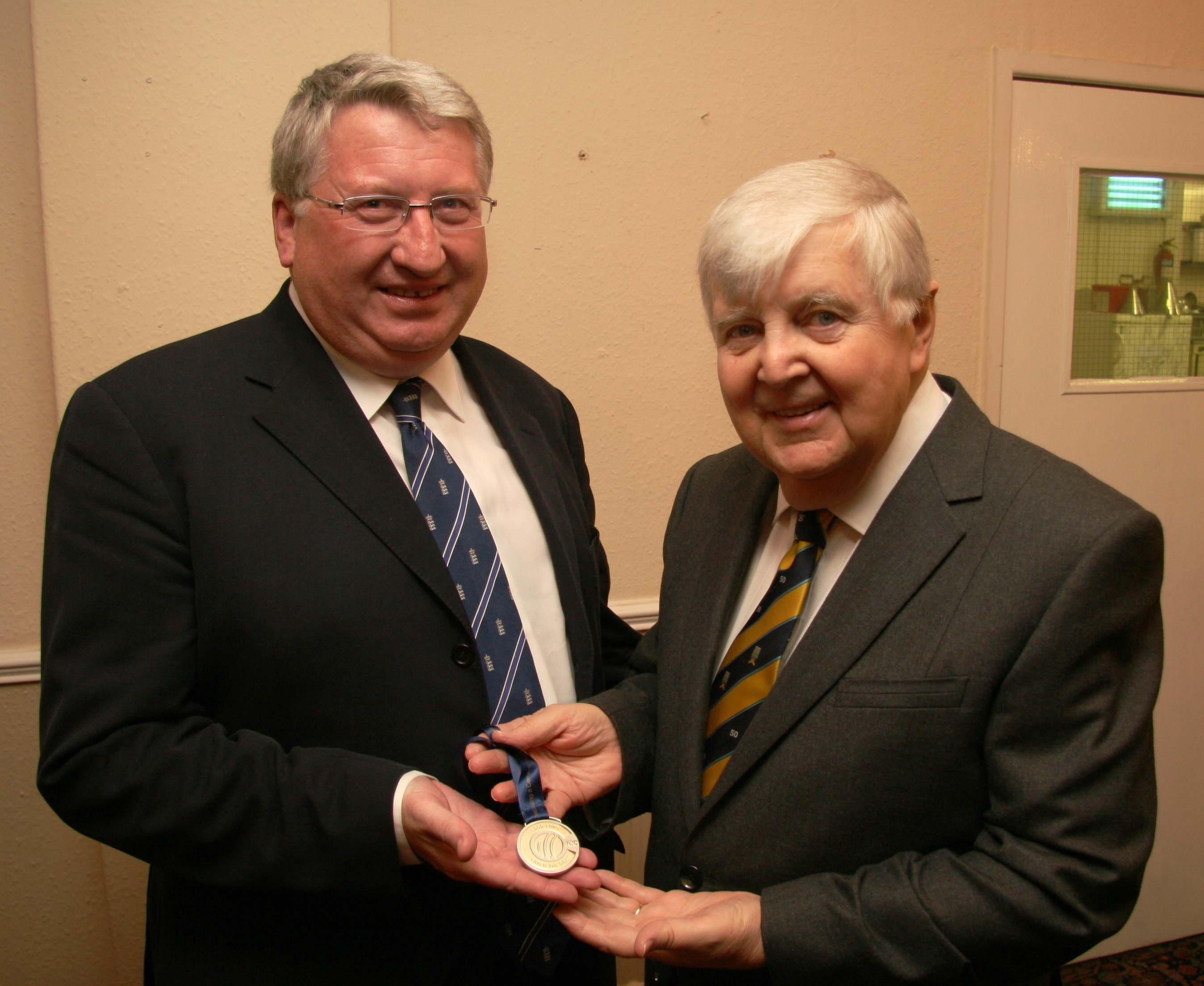
When ICC President David Morgan visited the Society to speak to members in November 2009 it was brought to his attention that David had been the Society’s Secretary since it was founded by David and his father in 1960 as well as giving stalwart service as a Sheffield representative on the Yorkshire Committee for 22 years.
The Society was delighted to learn that David was to be presented with the medal by David Collier during his visit on Monday, April 19. The ICC Centenary Medal recognises a group of people who are instrumental to the running of the game – the volunteers. They give their time for the benefit of others, and are crucial to preserving cricket’s special values as well as sustaining and developing the game at the grassroots and nurturing the future. The ICC are awarding Centenary Medals to 1,000 volunteers worldwide who have demonstrated exceptional commitment to the game and have gone beyond the call of duty in the name of cricket.
Spring Dinner 2009 – a Tribute to the side that launched Yorkshire’s modern Golden Age – Champions of 1959
Members of the Yorkshire squad who 50 years ago began the county’s modern Golden Age gathered for the Society’s 2009 Spring Dinner – Harold ‘Dickie’ Bird, Bryan Stott, Ray Illingworth, Ken Taylor, Philip Sharpe, Don Wilson, Jackie Birkenshaw, Bob Platt, Doug Padgett, Brian Close and Mel Ryan. The toast was proposed by Richard Barber – nephew of Alan Barber, who captained Yorkshire in 1929 and 1930 – and the full text of his speech is presented below.
“Curious magic that transported them from team to Superteam
I’m sure I’m not the only person here this evening who was given the chance to play for Yorkshire by being carried across the border a day before my birth in order to qualify for the county – from Baslow to Sheffield, in fact, in 1942. My uncle, Alan Barber, had captained Yorkshire in 1929 and 1930; my father, Bertie, captained Sheffield Collegiate for a decade in the 1930s, and my brother and I have Yorkshire cricket flowing in our veins. As a teenager I was called to the Headingley nets in the 1950s under the watchful eye of old Maurice Leyland – but alas no further!
In those days Bramall Lane was like a second home for me – unforgettable days cheering for the Blades in winter and the White Rose in the summer. At one Blades match in the 1950s someone in the crowd shouted out: “Don’t pass it to Pace, pass it to me – I’m not playing either!”
And as the match ended a man near me said to his neighbour: “Well, band played well!” You can’t fool ’em down at the Lane!
As for the old ground’s cricket atmosphere, John Warr, the captain of Middlesex in 1959, recalled fielding on the boundary to the right of the pavilion in front of where the flat caps used to watch: a steepling catch went up…he teetered for a long time underneath it…down it came, and straight through his hands to the floor – and a voice behind him called out: “Eh, lad! Whatever’s tha coom oop ‘ere foor? Has tha coom to buy penknife?”
I was 17 in 1959 when those great deeds were done by our guests this evening – and those southerners from Surrey unseated for a decade. These guys with us this evening were Titans: Derbyshire setting us 304 in 170 minutes at Chesterfield, and Ken Taylor got them with 144; Essex at Colchester, where the two Brians and Freddie scored 86 off eight overs to win; Hampshire at Hull, where Bryan Stott carried his bat for 130 and the last 105 came in 10 overs.
And then one of the most heroic days in the county’s history: the last match of the season on September 1, when Bryan Stott and Doug Padgett put Sussex to the sword at Hove by scoring 218 in 95 minutes to win with seven minutes to spare and five wickets in hand to take the Championship in a style that is sometimes shown in dreams.
1959 also confirmed the impression many of us have of the days of our youth – that the rain never rained, and that every summer’s day was a day of endless sun…because in 1959 it was so, and scarcely a single day’s play was interrupted by rain in that marvellous year. Every generation believes that things today are never quite as sunny as they used to be, and never quite measure up as they did when we were young.
I’m reminded of a rhyme about an old man sitting on a bench watching cricket:
And like a corncrake calling to an owl
Grim-faced and glowering, he began to curse,
Remarking with an unattractive scowl:
“The state of cricket goes from bad to worse!
“Where are the bowlers of my boyhood’s prime?
“Where are the batsmen of my pristine years?
“Where are the fielders of the former time?”
At which I raised my head and pricked my ears
And smiled; for there was Trueman’s bounding run
And Close’s rapier flashing in the sun.
The actual names in that old rhyme were Larwood and Woolley. But ours this evening are still Freddie and Brian – and Ray and Doug and Don and Phil and Ken…and all the great players assembled here tonight who gave us such pride and pleasure, and heroes and victory, in those sun-drenched days of 1959. What is there that really matters more than Yorkshire cricket? In the 19th Century it was said that Lord Hawke occupied the position in the British Empire second only to Queen Victoria, as captain of Yorkshire. In the 20th some thought that Wilfred Rhodes was descended directly from the Almighty!
From such company has the Yorkshire team of 1959 come down.
They were a Superteam. A Superteam isn’t just a bunch of very good players. A Superteam is what happens when the curious magic of shared purpose brings from every player something beyond himself, when exceptional players extract brilliance from less gifted colleagues, and when those colleagues push exceptional players into greatness. Team spirit is one thing. Superteam spirit is quite another! We witnessed that in 1959 – and most of that Superteam are with us here tonight!
How then to sum up the Yorkshire team of 1959, and how best to toast the place they have in our hearts and memories?
1959 saw another event of note in Yorkshire cricket: the passing of Abe Waddington, who played for Yorkshire between 1919 and 1929, took 100 wickets six times, and saw Yorkshire to four successive County Championships. It was of him that Neville Cardus wrote: “Waddington was the very essence of Yorkshire cricket. He was as if, one day, the Lord had taken up a lump of Yorkshire clay, and breathed life into it; and then said to it ‘Abe Waddington – go thou on to bowl at Pavilion End at Bramall Lane.’”
Gentlemen, you, too, are the very essence of Yorkshire cricket and of our county’s pride; and in pleasure given and enjoyed by all of us here this evening and by so many of the people of Yorkshire down the years, you have no rivals! Ladies and Gentlemen, it is my privilege to ask you all to be upstanding and drink the toast of the evening: To the Yorkshire team of 1959!”
by Richard Barber, April 2009
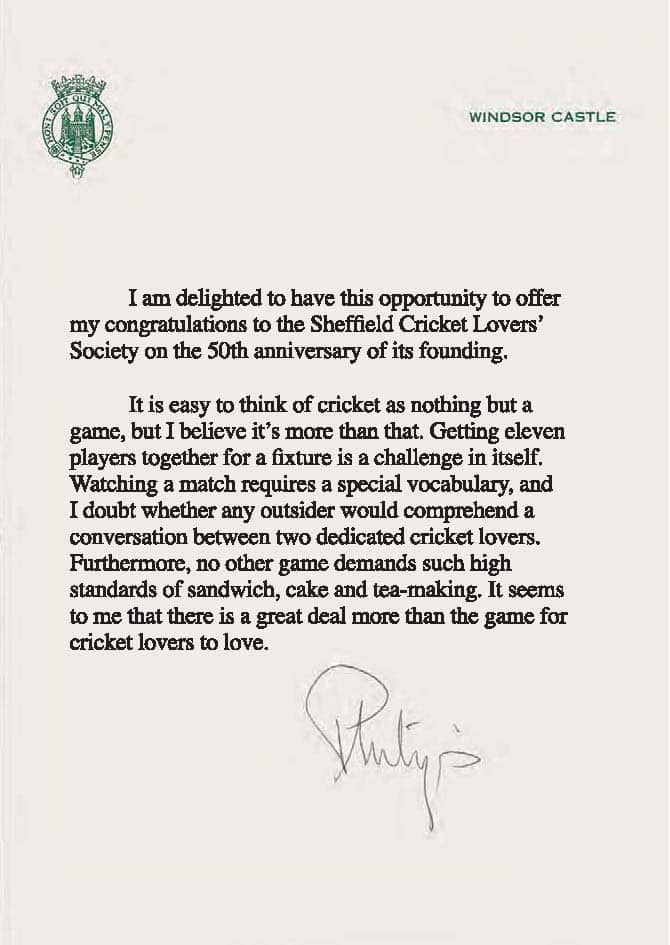
Letter from Prince Philip
Googlies & Giggles
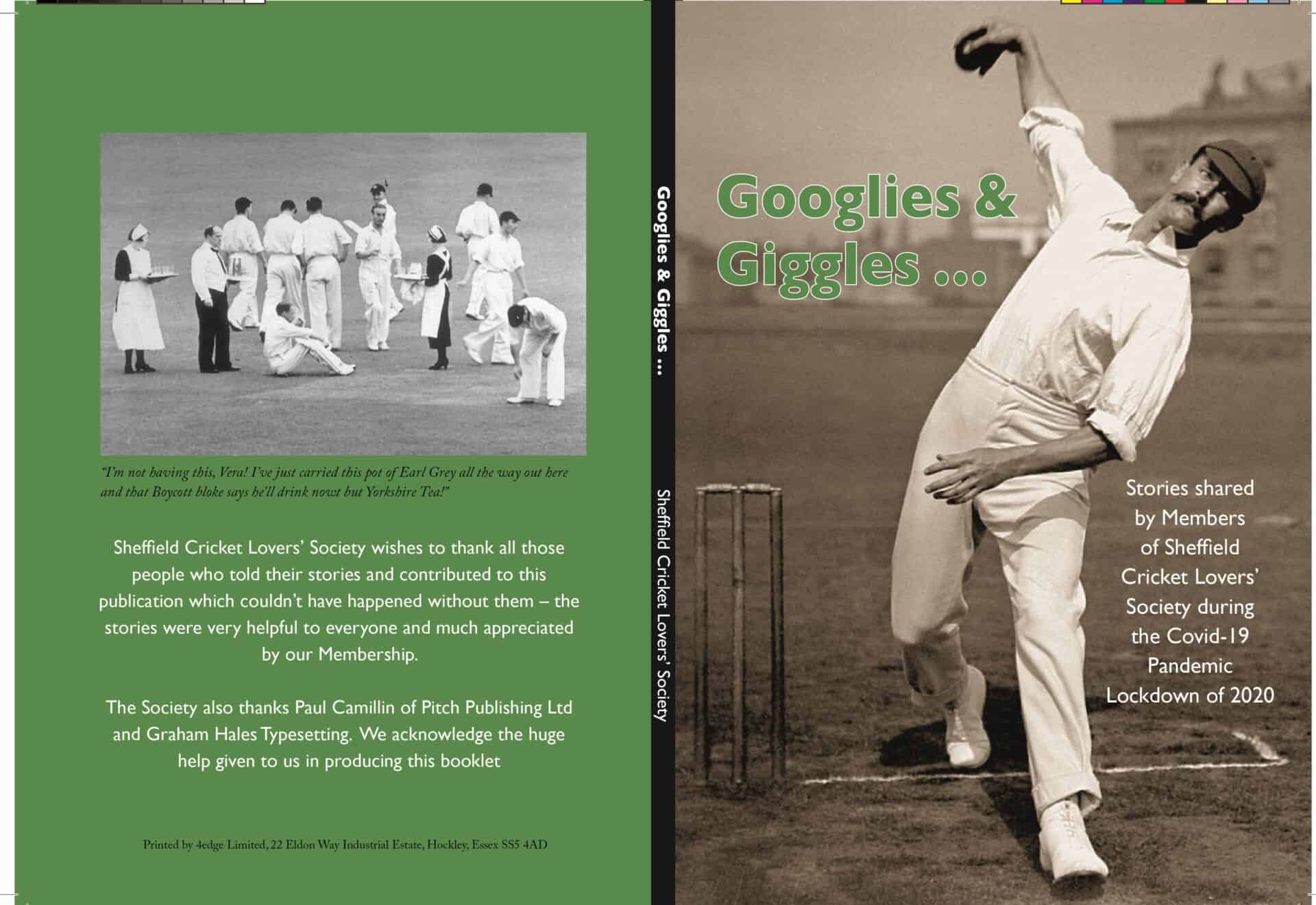
During the Covid Pandemic in 2020 some of our Members were feeling isolated and, looking for a way to get everyone interacting, we asked all of our Members for their stories over the years, of supporting cricket. We were delighted with just how many came back in and how people responded to each other. Eventually over the year we had enough to compile a printed book and with the help of some generous people in the print and production world ‘Googlies & Giggles’ was born.
One of the stories we are sharing with you here is from our late President, Sir Michael Parkinson.
You can read the whole publication – Googlies & Giggles – online here
An email and story from our late President, Sir Michael Parkinson
Below is an email and story from our late President, Sir Michael Parkinson. During the early part of the Covid Pandemic, one of our members said she was feeling very isolated so we wrote out asking all our members for their own stories of being a cricket supporter. We hoped we could share these and keep in touch with people, particularly those living on their own and, as we all were, pretty housebound for a while. It was a great success and we had enough stories to compile and make into a book. Googlies & Giggles was born with the generous help of Pitch Publishing and one was sent out to all our members to enjoy.
Please enjoy Sir Michael’s offering and we are considering doing a reprint if there were to be enough interest, if this is you, contact our Secretary, Jon Roddis
“Dear Dorothy
Sorry to have been a time in replying to your request but at last here is something to, hopefully, make members laugh. It a memory from an article I did for the Sunday Times in the 60s, later reprinted in 1969 and many editions since in book form. It’s just a memory of a visit to Bramall Lane where, as a young man and a young sports journalist, I was almost a permanent fixture reporting the cricket. It’s a memory from 1947 when I went to my first Roses game and it still sums up for me the venue, the way Yorkshire played cricket and, most of all, the humour of those who paid to see them.
Please give my best wishes to everyone.
Take care and much love, Michael”
“We queued for three hours outside Bramall Lane, Sheffield, and in that blessed moment when I was jostled through the turnstile, I felt as if I had arrived in Paradise. We sat on the hard concrete terracing of the football ground, knees drawn up under our chins, arms pinioned by one’s neighbours, and there we remained for the next eight hours in a state of acute physical discomfort sustained only by the knowledge that this was no ordinary cricket match.
To stand up to relieve cramped muscles was to invite an apple core or a pork pie crust to the back of the head along with the polite advice to ‘Sit thissen down Gladys.’
The Bramall Lane crowd has never been in sympathy with the physical discomfort of others. A few seasons later I was sitting on the same piece of concrete watching Yorkshire play Middlesex. It was during Compton’s golden days when his face shone from every hoarding advertising hair dressing. In Yorkshire, among the rank and file cricket supporters, at least, there was always a guarded attitude toward Compton. He was too flash for their tastes, too much of a fly boy. Brylcreem and cricket don’t mix in Yorkshire.
On this particular occasion Compton was granted a privileged insight into the way that the cricket lovers of Sheffield feel about the suffering of their fellow men. Yorkshire were batting when play was held up by the appearance on the field of what is called a Sheffield mongrel, which is to say a dog of exceedingly dubious parentage. The dog careered around the field defying the energetic attempts of the Middlesex side to catch it. It should be explained at this point that the sympathies of the Yorkshire crowd were entirely with the Middlesex men, it being a commonly held view in Yorkshire that dogs are for racing and not for petting.
Eventually it was Compton who caught it. It had to be, it was his year. He swooped low as the dog raced past him and scooped it triumphantly aloft. The crowd was relieved that the game could go on but remained unimpressed by Compton’s panache. Still brandishing the dog Compton trotted towards the pavilion and as he did so the creature, being born in Sheffield and therefore no respecter of personalities, bit him smartly on the arm. Compton dropped the animal and stood rubbing the bite. The huge crowd watched the performance dispassionately and then someone from the football terraces shouted: ‘Put some bloody Brylcreem on it Compton.’”
Michael Parkinson